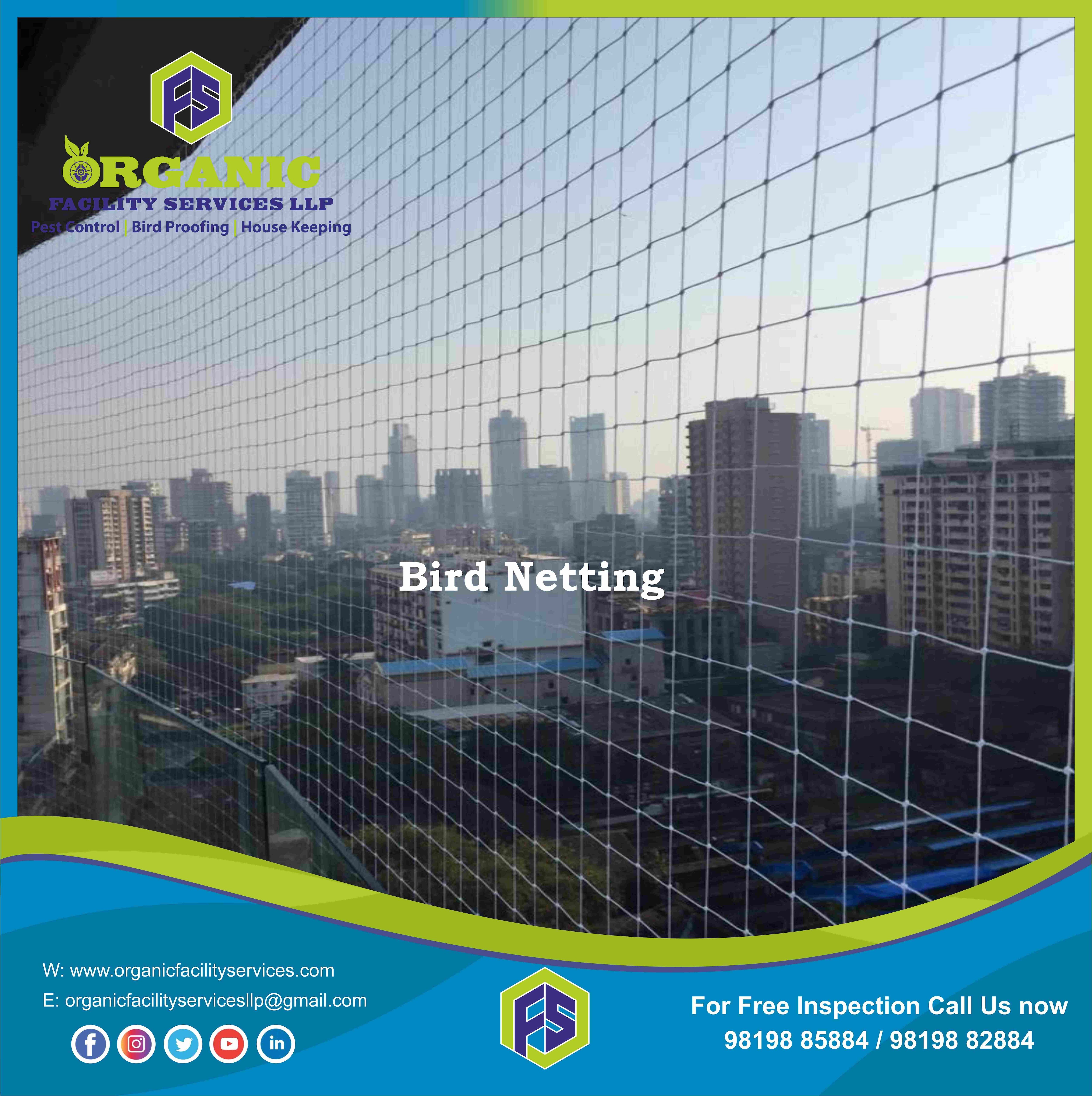
Bird netting suits an office when it can fully enclose a defined opening, ledge, shaft or atrium without blocking fire access, façade maintenance or building equipment. By checking the bird species, enclosure geometry, fixing substrate and operational constraints, you can decide whether netting is the right control or whether another system is safer and more practical.
Key takeaways
- Use netting for recessed ledges, lightwells, shafts, atriums, and façade voids.
- Pair netting with spikes, hygiene measures, or repairs for problems outside enclosed spaces.
- Record dimensions, access points, fixing surfaces, mesh, colour, tension, and maintenance access.
- Reject proposals that block fire routes, drainage, ventilation, inspection, or safe escape.
Which parts of a Mumbai office building are suitable for bird netting?
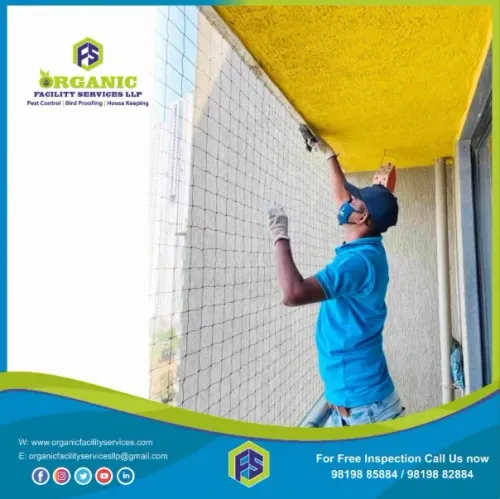
Netting works best as a physical exclusion system: it blocks birds from a defined space rather than persuading them to leave. That makes bird netting for offices in Mumbai suitable for recessed balconies, service ledges, lightwells, open shafts, atriums, enclosed terraces and façade voids.
| Area | Suitable when | Main limitation |
|---|---|---|
| Glass façades and façade voids | The net has a complete, taut enclosure with secure perimeter fixings | Gaps at corners, beams, drains, pipe penetrations or façade junctions let birds re-enter |
| HVAC equipment and service ducts | The mesh encloses the equipment without blocking airflow, servicing or drainage | A loose net can foul fans, obstruct access or collect debris |
| Parking areas and loading bays | The net forms a full enclosure around the covered zone | Open sides and vehicle movement leave entry routes |
| Parapets, projecting signs and roof equipment | Only when a designed enclosure prevents landing outside it | Exposed surfaces let birds land beyond the net |
A net will not stop pigeons landing on an open parapet, and it will not work if a small tear or unsealed penetration remains. Before choosing pigeon exclusion, identify whether mynas, sparrows, crows or bats use the space; a mesh suitable for pigeons can admit smaller birds, while bats require a different assessment.
Complete enclosure is the core requirement for bird protection for commercial buildings.
What bird problems does netting solve, and which controls belong elsewhere?
Netting is exclusion: it blocks bird entry into a defined enclosed void and prevents roosting, nesting and fresh droppings there. It does not remove birds already behind the mesh, and it cannot stop birds landing on an open parapet, projecting sign or roof unit.
| Control or location | What it solves | Where another control is needed |
|---|---|---|
| Balcony netting | Encloses recessed balconies and blocks pigeon entry | Open parapets need spikes, wires or another landing deterrent |
| Shaft netting | Seals lightwells, service shafts and atriums | Release trapped birds before closing the final gap |
| Terrace netting | Protects an enclosed terrace or defined equipment bay | Open roof areas need exclusion covers, deterrents or housekeeping |
| Façade exclusion netting | Closes recessed ledges and façade voids | Avoid it where an unobstructed façade or frequent access is essential |
| Pigeon spikes or bird wires | Discourages landing on narrow ledges and signs | They do not seal a large void or stop entry through openings |
| Gels or visual deterrents | Discourage landing at selected exposed points | They require maintenance and do not replace physical exclusion |
| Sanitation and nest removal | Removes fouling, nesting material and attractants | They do not prevent a bird returning through an open gap |
Pigeon nets commonly use apertures of about 19–25 mm. Sparrows and other smaller birds need a tighter, species-matched aperture; identify the birds before specifying mesh.
Wet accumulated droppings before removal, then use gloves, eye protection and a suitable respirator, with sealed waste bags and controlled disposal. Check the Wild Life (Protection) Act, 1972 and applicable animal-welfare requirements before disturbing active nests, eggs or nestlings.
A plan for commercial bird control in Mumbai must address trapped birds before installation, not after it.
What should an office survey and net specification record?
Record the survey and specification before approving bird net installation for offices; a sketch with dimensions and photographs is more useful than a product name.
1. Inspect and record the target species, active nests, entry points, affected dimensions, ledges, drainage routes, existing façade anchors, fixing substrates, equipment clearances and the route for future maintenance.
2. Require a written plan for birds already inside the proposed enclosure. Do not close the final gap until lawful, humane nest handling and bird-release arrangements are complete; trapped birds can die behind the mesh, leaving carcasses and droppings.
3. Specify UV-stabilised polyethylene or nylon rated for outdoor exposure. Match the aperture to the species: pigeon netting is commonly about 19–25 mm, while sparrows require a tighter mesh. State the required tensile strength, perimeter cable or frame, tensioners, edge cables, anchors, brackets and sealed penetrations.
4. Select corrosion-resistant hardware for Mumbai’s humidity, monsoon rain and coastal salt. The survey must identify each fixing point and confirm that it will not damage glass, painted metal, waterproofing, cladding, post-tensioned elements or concealed building systems. Do not attach to a weak parapet cap or service pipe.
5. Show how the taut enclosure will preserve drainage, ventilation, façade access and equipment servicing. Mark every corner, beam, pipe penetration and junction so the installer cannot leave a usable gap, and include inspection access for loose mesh, corrosion and failed fixings.
When is netting the wrong choice for an office building?
Netting is the wrong choice where it conflicts with the façade, access plan or life-safety systems. Reject or redesign it for:
- Heritage façades where anchors, visible mesh or sealed penetrations would damage historic fabric.
- High-wind elevations where movement can loosen cables, clips or anchors.
- Prominent elevations that require an unobstructed architectural appearance.
- Moving façade systems that open, fold or change position.
- Windows and façades needing frequent cleaning, inspection or rope-access work.
A design must preserve emergency egress, fire escapes, smoke vents and fire-fighting access. It must also leave maintenance hatches, required window openings, sprinklers, lights, cameras, exhausts, shutters, HVAC servicing routes and drainage fully usable; a net obstructing any of these creates a greater management risk than bird fouling.
Treat bird protection for commercial buildings as an operating asset, not a maintenance-free product. Inspect for slack mesh, torn sections, failed clips, corrosion, bird impact, leaves and blocked drains, with additional inspections after monsoon storms or façade work.
A small tear can become a usable entry point for pigeons, even when it is invisible from ground level. Record defects, isolate unsafe areas and repair the perimeter cable, tensioners or fixing system rather than simply patching the visible hole.
“Maintenance-free” is not a valid commercial specification; require an inspection frequency, access method and repair responsibility.
How should a Mumbai office approve a bird-control proposal?
Approve netting when the affected zone is recessed or enclosed, the fixing line can be inspected, the target species are identified, and emergency access, escape and building operations remain intact. Reject it for an open parapet or façade where birds can simply land outside the enclosure.
For commercial bird control in Mumbai, ask for a written survey before approving bird net installation for offices. It should record:
- Dimensions, mesh aperture, material, UV rating and tensile-strength information
- Cable, tensioner, bracket and anchor details, substrate condition and corrosion protection
- Access equipment, equipment clearances and protection for glass, cladding, waterproofing and concealed services
- Plans for birds or active nests already inside, including humane release procedures
- Warranty limits, inspection frequency and the route for repairs, cleaning and future maintenance
A proposal for bird netting for offices in Mumbai should preserve fire escapes, smoke vents, firefighting routes, maintenance hatches, windows, sprinklers, lights, cameras, exhausts, shutters and drainage. A commercial provider must compare the method with other controls:
| Option | Best use | Main limitation |
|---|---|---|
| Netting | Enclosed voids and ledges | Fails at gaps or trapped birds |
| Spikes or wires | Exposed parapets and signs | Does not exclude birds from open spaces |
| Gels, covers or sanitation | Landing points and hygiene | Requires correct placement and repeat maintenance |
Organic Facility Services LLP is one provider to evaluate, but compare its documented method, safety controls and maintenance plan rather than choosing on proximity alone.
Related product
Bird Netting Service The bird is one of the major pest in now a days which cause no. of respiratory diseases. View product → |
Frequently asked questions
Which parts of a Mumbai office building are suitable for bird netting?
Netting suits recessed balconies, service ledges, lightwells, open shafts, atriums, enclosed terraces, and façade voids where installers can create a continuous barrier.
What bird problems does office bird netting solve?
It prevents birds from entering defined spaces, reducing nesting, droppings, feathers, noise, and contamination. Spikes, hygiene work, deterrents, or repairs address problems outside the netted area.
What should an office bird-netting survey record?
Record each opening’s dimensions, bird activity, fixing surfaces, access equipment, drainage, ventilation, fire routes, mesh specification, colour, tension, warranty, and maintenance access.
When is bird netting the wrong choice for an office building?
It is unsuitable when the area needs unrestricted access, ventilation, daylight, emergency egress, frequent inspection, or a fixing method that would damage the façade.
How should a Mumbai office approve a bird-control proposal?
Compare the survey, drawings, mesh and fixings, installation method, safety plan, maintenance access, warranty, exclusions, and post-installation inspection before approving the work.
Keywords